
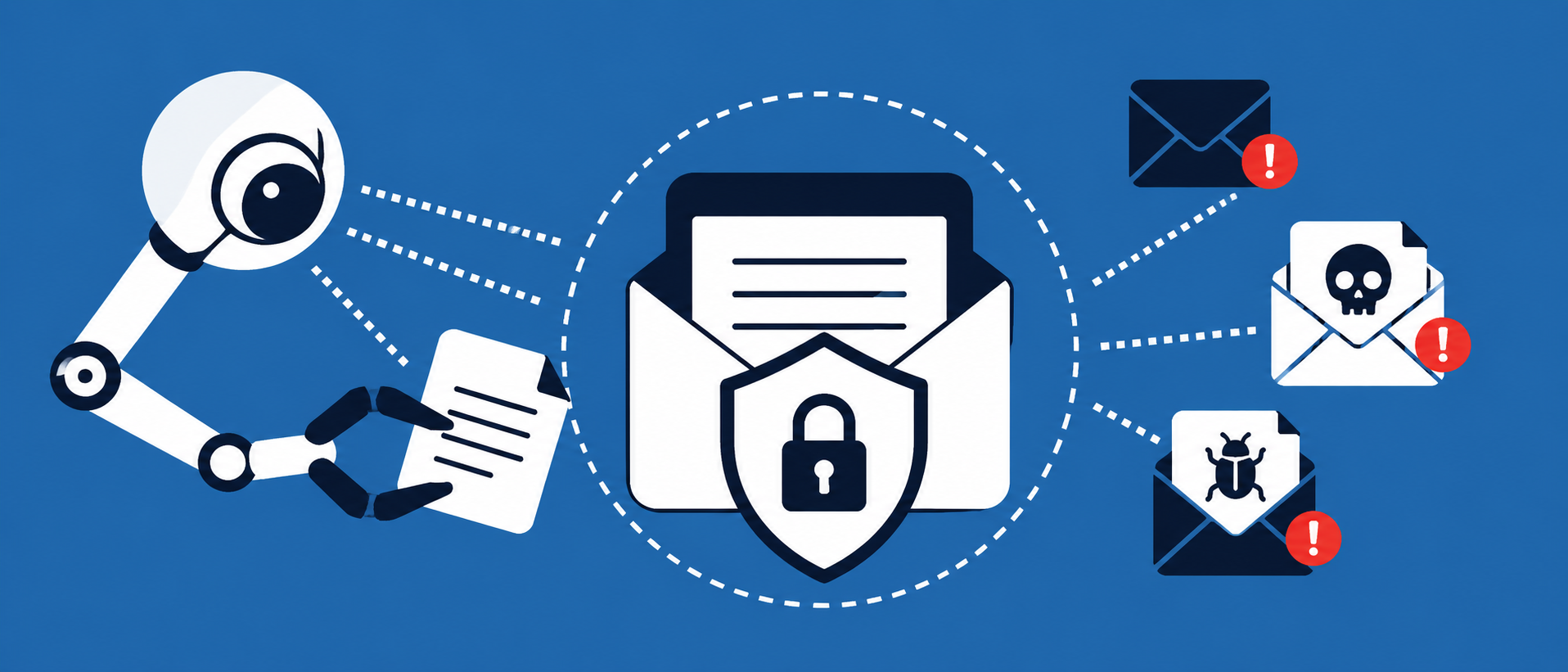
Why AI Spam Scanners Are a Bad Idea for Email Privacy
AI is being pushed into almost every corner of the internet. Some of it is useful. Some of it is marketing hype. Some of it is dangerous because it sounds clever while quietly creating new risks.
AI-based spam scanning belongs in that last category.
At first glance, it sounds attractive. A smarter spam filter. Better detection. Less junk. Fewer phishing emails. Maybe even automatic understanding of suspicious messages.
But email is not just “data”. Email is private communication. It contains invoices, contracts, passwords, reset links, personal conversations, medical details, business negotiations, legal issues, customer data and internal company information. Feeding that into AI systems is not a small technical choice. It is a privacy decision with serious consequences.
And under GDPR, that matters.
Email scanning already touches sensitive ground
Traditional spam filtering is already a form of content processing. A server receives an email, checks headers, sender reputation, links, attachments, keywords, signatures and known patterns. That is not privacy-free, but at least the process can be limited, local and predictable.
AI scanning changes the nature of the problem.
Instead of checking whether an email matches known spam behaviour, an AI system may analyse meaning, context, writing style, intent and relationships between words. That means the system may process far more of the actual message content than a normal spam filter needs to.
That immediately raises a simple question:
Why should an AI system read private email content just to decide whether something is spam?
GDPR requires personal data to be processed lawfully, fairly, transparently and only for specified purposes. It also requires data minimisation, meaning you should not process more personal data than necessary. (GDPR)
That is where AI spam scanning becomes hard to justify.
Spam filtering does not need to become AI training
One of the biggest risks is not only that AI scans the email.
The bigger concern is what happens after that.
Is the email content used only for that one spam decision? Is it stored? Is it logged? Is it sent to a third-party AI provider? Is it used to improve the model? Is it retained for abuse analysis? Can employees of the provider access it? Is it transferred outside the EU? Can the model later reproduce fragments of what it has seen?
Those are not paranoid questions. They are basic privacy questions.
AI systems are often improved by learning from input data. That may be acceptable when the data is public, synthetic or deliberately submitted for training. It is a very different story when the input is private email.
Spam emails may still contain personal data. They may include real names, addresses, phone numbers, leaked credentials, order details, hacked mailbox content or copied conversation threads. Phishing emails often quote real companies, real people and real transactions. Even junk email can contain personal data.
So saying “it is only spam” does not solve the problem.
A spam message can still be personal data. A false-positive spam message can be even worse, because it may be a legitimate customer email, invoice, support request or private conversation.
The “AI learns from spam” problem
If an AI spam scanner learns from email content, there is a risk that private information becomes part of a model improvement process.
That creates several problems.
First, there is the issue of consent and transparency. Did the sender know their email might be used to train an AI system? Did the recipient know? Was this clearly explained? Was there a real choice?
Second, there is purpose limitation. An email was sent to communicate with someone. It was not sent to become training material for a spam detection model.
Third, there is data minimisation. A spam scanner may need to inspect certain technical signals. It does not automatically need to feed entire messages into a learning system.
Fourth, there is retention. If email content is stored for model training, review or future improvement, how long is it kept? Who can delete it? Can a specific person’s data be removed from the model later?
That last point is especially uncomfortable. GDPR gives people rights over their personal data, but AI models can make deletion and correction difficult once information has been absorbed into training processes.
Third-party AI scanning creates processor and transfer risks
Many AI spam scanners will not run fully on the mail server itself. They may send data to an external service.
That creates another layer of legal and operational risk.
The hosting provider, email provider or company using the scanner needs to know exactly what happens to the data. Who processes it? Where is it processed? Is there a proper data processing agreement? Are there sub-processors? Is data transferred outside the EU? Is the data used only for spam detection or also for product improvement?
Under GDPR, accountability is not optional. The organisation processing personal data must be able to show that processing is compliant. (GDPR)
With many AI services, the answer is often hidden behind vague privacy wording such as “service improvement”, “abuse monitoring”, “quality enhancement” or “model optimisation”.
That is not good enough for private email.
False positives become more dangerous
A classic spam scanner can usually explain why something was blocked. Bad sender reputation. Known malicious URL. SPF failure. DKIM failure. Suspicious attachment. Blocklisted IP. Too many spam-like patterns.
AI decisions can be harder to explain.
If an AI scanner blocks an important business email, how do you prove why? How do you correct it? How do you prevent it happening again? Can the customer understand the reason? Can the system administrator audit it properly?
Black-box filtering is not a good fit for business-critical communication.
Email is infrastructure. It needs predictable behaviour. When something goes wrong, support teams need logs, rules, headers and evidence. “The AI thought it looked suspicious” is not a proper operational answer.
Privacy by design means avoiding unnecessary exposure
A privacy-friendly spam strategy should start with the least invasive methods:
Reputation checks. SPF, DKIM and DMARC validation. Rate limits. Greylisting where appropriate. Malware signatures. URL reputation. Attachment scanning. Local rules. Known spam patterns. User-controlled quarantine. Clear logs.
These methods are not perfect, but they can be implemented in a controlled way without turning private mailboxes into AI training material.
AI should not be the default answer just because it is fashionable.
For email, the better principle is simple:
Do not let more systems read private mail than absolutely necessary.
AI spam scanning may create more risk than value
The promise of AI spam filtering is better detection.
The cost may be loss of privacy, unclear data processing, third-party exposure, GDPR complexity, difficult auditing and the possibility that private or sensitive content becomes part of a learning system.
That is a bad trade-off.
Spam protection is important. Phishing protection is important. Malware protection is important. But privacy is also important. Especially with email.
A good mail platform should protect users without unnecessarily exposing their communication. Security should not become an excuse to feed private content into systems that users do not understand, cannot audit and may not be able to control.
Our position
AI has its place, but private email content should be treated with extreme care.
For spam scanning, we believe the safest approach is to use proven, transparent and privacy-conscious filtering methods first. Keep processing as local and limited as possible. Avoid sending message content to third-party AI systems unless there is a very clear legal, technical and operational reason to do so.
Because once private email becomes AI training material, the damage may already be done.
And no spam filter is worth that.
